The 2026 List Industry Icons
Flush-Locks
Flush-Locks Named a 2026 Industry Icon in Enterprise Technology & SaaS
Recognized for developing a patented smart lock system that brings contactless access control, real-time monitoring, and operational intelligence to commercial facilities management.
paidrestrooms.com/
Recognized for rethinking public restroom access as connected infrastructure, combining secure entry, embedded payments, occupancy monitoring, merchant controls, analytics, and a business model designed to make clean restrooms more available.
FMFreeman Inc. / Flush-Locks has been selected as a 2026 Industry Icon in Enterprise Technology & SaaS by The 2026 List, brought to you by Industry & Influence, recognizing the company’s smart-infrastructure vision, rapid proof-of-concept execution, payment-enabled access model, and effort to create a new economic framework for public restroom availability.
Public restroom access is a basic need.
It is also one of the most inconsistent pieces of urban infrastructure.
People can be surrounded by restaurants, shops, transit, offices, and other public-facing businesses and still find themselves unable to access a restroom when they need one.
Flush-Locks was created from that personal frustration.
A Personal Problem Became an Infrastructure Idea
Founders Floyd and Marisol Freeman’s idea began after they experienced the difficulty of finding accessible restrooms while traveling with their family.
That frustration gave the company a very specific mission.
Instead of asking only how to secure a restroom door, Flush-Locks asks how restroom access itself could become a connected, manageable, and economically sustainable service.
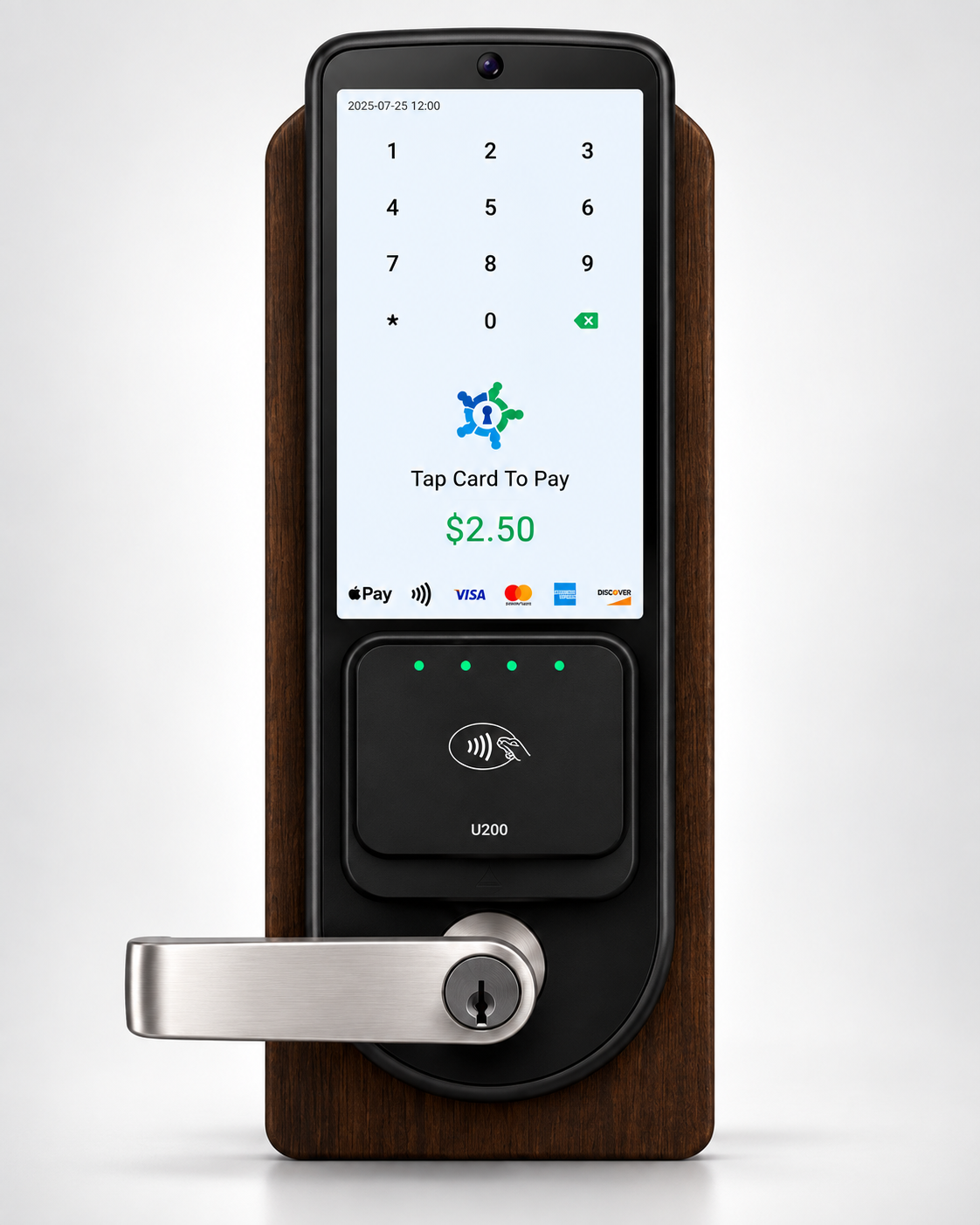
The result is a model built around payment-enabled smart locks.
Users can pay specifically for restroom access.
Businesses can control and monitor that access.
The restroom becomes a small piece of connected public infrastructure rather than a space that is either completely open or completely unavailable.
The Innovation Is Bigger Than the Lock
Flush-Locks is not positioning itself as a smart-lock manufacturer alone.
The company describes an entire restroom-access ecosystem.
That system includes secure access, embedded payments, occupancy monitoring, anti-tailgating features, merchant controls, analytics, and a connected network.
Each piece solves a different part of the problem.
The lock manages entry.
Payments create an economic model.
Occupancy monitoring gives operators visibility.
Anti-tailgating is designed to help reduce unauthorized entry.
Merchant controls give businesses more authority over how the restroom is used.
Analytics create information that can help operators understand activity over time.
Together, those components turn access control into infrastructure.
A Business Incentive Can Expand Public Access
One of the most important ideas behind Flush-Locks is economics.
Businesses often have good reasons to restrict restroom use.
Cleaning costs money.
Damage costs money.
Unauthorized or excessive use can create operational problems.
Staff may not have time to manage constant requests.
Flush-Locks is designed to give businesses a reason to make a restroom available rather than simply keeping the door locked.
If access can be controlled and monetized, the restroom may shift from being viewed only as a cost center to becoming a managed service.
That creates a potential win for both sides.
The public gains access.
The business gains more control over the conditions under which that access is provided.
Proof of Concept in Less Than a Year
One of the achievements Floyd is most proud of is proving that the concept could move from idea to reality in less than one year.
As a non-technical founder, he had to build a team that believed the system could be created.
The company then moved beyond the concept stage and into live locations.
That milestone mattered for two reasons.
First, it showed that the technology could be built.
Second, it showed that customers were willing to use it.
For an early-stage infrastructure concept, those are fundamentally different forms of validation.
A prototype proves possibility.
Real customer use begins to prove demand.
Live Locations Validate the Mission
Flush-Locks says its live locations demonstrated that people would pay for restroom access.
That willingness matters because the business model depends on actual behavior, not just theoretical interest.
Many infrastructure ideas sound useful until they meet the real world.
Users have to understand the system.
The payment process has to feel reasonable.
Businesses have to see operational value.
The technology has to work reliably in a physical environment.
Flush-Locks’ early live deployments gave the company a chance to test those assumptions.
Major-City Pilot Interest Expands the Opportunity
The company also says its first pilot program has been accepted by major cities as a potential win-win approach.
That is an important part of the story because restroom access is not only a private-business issue.
It is also a public-space issue.
Cities face constant tension between availability, sanitation, safety, staffing, maintenance, and operating cost.
A payment-enabled access model could create another option between fully public access and complete restriction.
Flush-Locks believes that opportunity can extend across the United States.
The value proposition is strongest where demand for restrooms is high but traditional public-access models have not worked consistently.
Connected Restrooms Create Data
The analytics component also changes what operators can know.
Traditional restroom access often produces little useful information.
A business may know that people are using the facility, but not how often, when demand is highest, or how access patterns change over time.
Connected access creates the possibility of better visibility.
Occupancy and usage data can help merchants understand patterns.
Controls can be adjusted.
Operations can respond to demand.
The restroom becomes measurable infrastructure.
That creates a foundation for more informed management.
A New Category Between PropTech and Public Infrastructure
Flush-Locks sits in an unusual category.
It has elements of PropTech, smart infrastructure, payment technology, access control, and facilities management.
That combination is part of what makes the idea distinctive.
The company is taking technologies that already exist in other contexts and applying them to a very specific public-access problem.
Its innovation is not simply one feature.
It is the way those features are assembled into a new operating model for restrooms.
Why Flush-Locks is a 2026 Industry Icon
The 2026 Industry Icon designation recognizes organizations demonstrating meaningful innovation, leadership, momentum, industry impact, and the ability to influence what comes next within their respective fields.
FMFreeman Inc. / Flush-Locks was selected for rethinking restroom access as a connected infrastructure problem rather than only a lock-and-key problem.
Its payment-enabled access model, live proof of concept, merchant controls, occupancy monitoring, anti-tailgating features, analytics, and early pilot interest demonstrate an effort to create a new category around a basic public need.
For its smart-infrastructure vision, rapid execution, real-world validation, and attempt to give both businesses and the public a better model for restroom access, FMFreeman Inc. / Flush-Locks has been selected as a 2026 Industry Icon in Enterprise Technology & SaaS.
Explore Flush-Locks
Explore all 100 Industry Icons
View All Honorees